How old are the origins of the Glera grape variety used to produce Prosecco sparkling wine?

The short answer

No one can put an exact date on it. The grape behind Prosecco has been grown in northeast Italy for centuries: the wine called "Prosecho" was already famous in 1593, writers linked it to a Roman wine called Pucinum, and the grape is recorded under the name Prosecco in 1772. Since 2009 its official name has been Glera.

Answered by Michael Goldstein · Founder, Bella Principessa
Updated on

The full answer

In this answer 6 parts
  1. The short answer
  2. The timeline, from legend to label
  3. Why the grape changed its name
  4. What the grape is like
  5. Is Glera the only grape in Prosecco?
  6. Old grape, young wine

No one can put an exact date on it. The grape behind Prosecco has been grown in northeast Italy for centuries: the wine called “Prosecho” was already famous in 1593, writers linked it to a Roman wine called Pucinum, and the grape is recorded under the name Prosecco in 1772. Since 2009 its official name has been Glera.

Its exact birthplace is debated: some place it in the Karst around Trieste and the Slovenian border, others in Istria or the Veneto.

Every old grape comes with an origin story. The honest version is better than the legend, because you can see which parts are documented and which parts are tradition.

The timeline, from legend to label

  • 1st century: Pucinum. Pliny the Elder praised Pucinum, a wine from the coast near today’s Trieste, and wrote that the Empress Livia credited it for her long life (she lived to 86). Nobody knows which grape made it. The link to Glera is a tradition, not a proven fact.
  • 1593: “Prosecho.” The English traveler Fynes Moryson, touring northern Italy, wrote that the wine Pucinum was “now called Prosecho.” That’s one of the first known uses of the name, and it ties it to the village of Prosecco, near Trieste.
  • 1754: the first poem. Aureliano Acanti mentions Prosecco in his poem “Il Roccolo Ditirambo.”
  • 1772: the grape on record. Francesco Maria Malvolti writes about the grape under the name Prosecco in the Giornale d’Italia, according to the local consortium’s history. It’s the first firm record of the grape in the area: proof it was there by then, not the year it arrived.
  • Late 1800s: the bubbles. Winemakers in the Treviso hills learn to make it sparkle reliably in pressure tanks. What is the Martinotti method?
  • 2009: a new name. The grape is officially renamed Glera when Prosecco DOC is created.

Why the grape changed its name

For centuries, Prosecco was the name of a village, a grape and a wine. That was a problem: if Prosecco is a grape, anyone, anywhere, can plant it and put “Prosecco” on the label. In 2009, Italy made Prosecco a protected place name and renamed the grape Glera, an old local name from Friuli. Since then, only wine from the defined area of northeast Italy can be called Prosecco. Some wine writers still call the grape Prosecco out of habit.

Is Prosecco a place or a grape?

What the grape is like

Glera is a white grape with thin, golden skins and large, loose bunches. It’s naturally fresh and aromatic, which is why Prosecco tastes of green apple, pear, white peach and white flowers rather than toast. It’s picked in September and made to be drunk young. There’s also a long-bunched cousin, Glera Lunga, one of the grapes allowed in small amounts in Prosecco DOC.

What’s so special about Prosecco grapes?

Is Glera the only grape in Prosecco?

Almost. White Prosecco DOC must be at least 85% Glera. Prosecco DOC Rosé is 85 to 90% Glera with 10 to 15% Pinot Noir.

What are the main grape varieties used in Prosecco?

Old grape, young wine

The grape is centuries old, but the sparkling wine most people mean by Prosecco is a modern one: tank-fermented bubbles from the late 1800s, a protected name from 2009 and a rosé from 2020. It’s an ancient variety that tastes best when the wine is as young as possible.

What is the history of Prosecco?

That’s the idea behind Bella Principessa Prosecco DOC: 100% Glera from the Prosecco DOC area, made by a fourth-generation family winery in the Veneto, for the way people drink Prosecco now.

Meet Bella Principessa Prosecco DOC
The long read, in the JournalThe Charmat method: how Prosecco gets its bubbles6 min read →

SourcePliny the Elder, Natural History, book 14; Fynes Moryson, An Itinerary (1617), describing his 1593 travels; Conegliano Valdobbiadene consortium history (1772 reference); Prosecco DOC Consortium.

Keep this answer

Print it, save it, or send it to whoever asked.

More in this topic

Grapes and how it’s made

How is Prosecco made?

Prosecco begins with grapes fermented into base wine. For Prosecco DOC spumante, a second fermentation in sealed pressure tanks creates the bubbles before bottling. This is the Martinotti or Charmat method. The cork gets the applause; the yeast has done the work.

From base wine to bubbles, for white and rosé
What are the main grape varieties used in Prosecco?

Glera is Prosecco’s main grape. White Prosecco DOC requires at least 85% Glera, with other permitted varieties limited to 15% combined. DOC Rosé requires 85–90% Glera and 10–15% Pinot Nero vinified as red wine. White Prosecco can be 100% Glera, so not every bottle is a blend.

Glera, the blend and what each grape adds
What’s So Special About Prosecco Grapes?

Glera, Prosecco's principal grape, contributes acidity and fruit and floral aromas. Growing conditions and winemaking shape how those qualities appear in the glass. Tank fermentation can highlight that fresh character; the grape alone does not explain every difference between bottles.

What Glera adds, and why the growing matters
What other grapes can be used to make Prosecco?

White Prosecco DOC may include up to 15% permitted varieties alongside Glera, including Chardonnay, Pinot Grigio and several local grapes. Rosé follows a different rule: Glera with Pinot Nero vinified as red wine. The permitted list describes possibilities, not the recipe of every bottle.

The permitted grapes, and red grapes in white wine
How are Prosecco’s Glera grapes harvested?

Glera grapes are harvested when their ripeness suits the intended Prosecco, balancing sugar, acidity and grape condition. The date varies with the site and season. Picking methods vary too, so a photograph of a hillside harvest does not describe every bottle on the shelf.

When the grapes are picked, and whether by hand
What is Prosecco grape harvest yield?

Harvest yield measures grapes grown per area. The Prosecco DOC specification lists a base maximum of 18 tonnes per hectare for Glera and 13.5 for Pinot Nero used in rosé. These are regulatory limits, not actual vineyard averages; harvest-year measures can affect what is permitted.

The DOC limits and grape-to-wine yield
What is Prosecco grape pressing?

Prosecco grape pressing extracts the juice, called must, that will become wine. For white-wine production, gentle pressing separates juice from grape skins before fermentation. The juice then settles so the cellar can separate it from suspended solids.

What pressing does, and when the bubbles form
What is Prosecco’s first fermentation?

Prosecco’s first fermentation turns grape juice into base wine as yeast converts sugar into alcohol. For DOC spumante, a later fermentation retains the bubbles. First comes the wine; the entrance comes later.

From juice to base wine, for white and rosé
What is the Martinotti method?

The Martinotti method, also called Charmat or the tank method, gives Prosecco DOC spumante its bubbles through a second fermentation in a sealed pressure tank. Yeast produces carbon dioxide, which stays in the wine under pressure. Three names, one useful idea: keep the gas in the wine.

How the pressure tank works, for white and rosé
What are the methods of making sparkling wine?

Sparkling-wine techniques include the traditional method, tank method and ancestral method. They differ in where fermentation happens and how carbon dioxide is retained. A similar stream of bubbles can conceal a rather different cellar story.

Bottle, tank and ancestral methods compared
How are the bubbles in Prosecco formed?

Prosecco’s bubbles come from carbon dioxide made by fermentation. In Prosecco DOC spumante, a second fermentation in a sealed tank retains the gas under pressure. Opening the bottle releases that pressure, letting the bubbles appear and rise through your glass.

How fermentation makes them, and why they fade
What is wine fermentation?

Wine fermentation is the process in which yeast converts grape sugars into alcohol and carbon dioxide. In Prosecco DOC spumante, a second fermentation in a sealed tank produces the retained sparkle. The bubbles get noticed, but the first transformation is juice becoming wine.

How yeast makes wine, and the second fermentation
What is wine terroir?

Wine terroir describes the growing environment behind a wine, including climate, soil and the vineyard's physical setting. It helps explain why the same grape can make different wines in different places. It is a useful idea about growing conditions, not a claim that you are literally tasting a handful of soil.

Place, people and what it means for Prosecco
What are tannins?

Wine tannins are natural plant compounds called polyphenols that contribute a drying or gripping sensation in the mouth. They come from grape skins, seeds, stems and sometimes oak. Tannin grip differs from low sugar and acidity: a dry wine can have little noticeable tannin.

Where they come from, and whether Prosecco has them

All 113 Prosecco questions →

Share a moment.
One sip at a time.
Made in Italy.

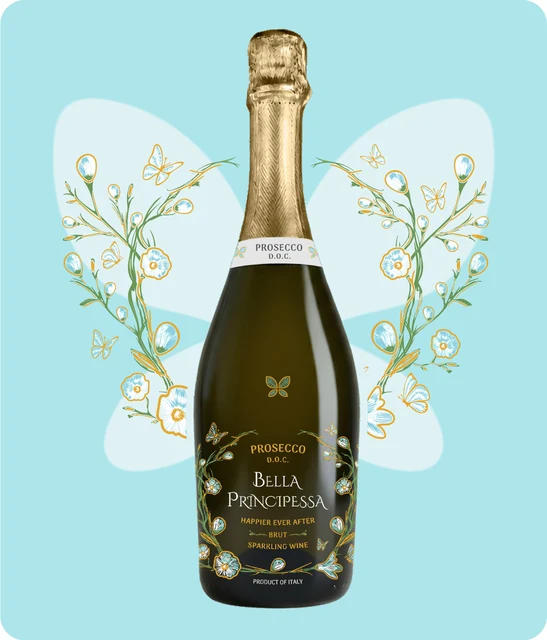
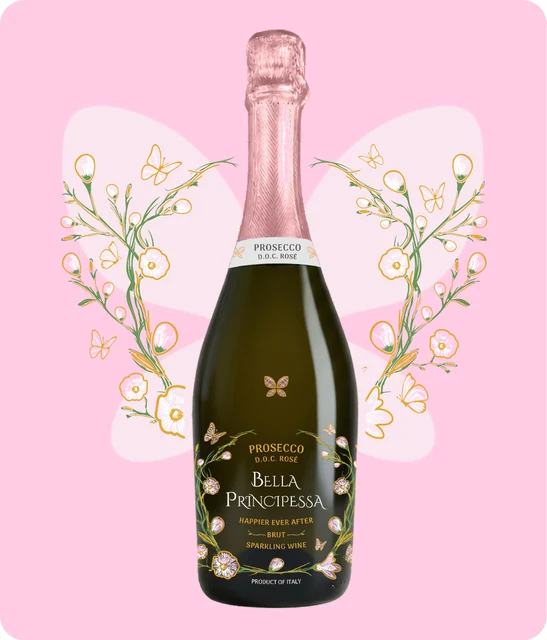
Bella Principessa Prosecco DOC on a blue butterfly card Bella Principessa Prosecco DOC Rosé on a pink butterfly card