The short answer
DOC stands for Denominazione di Origine Controllata, Italian for "controlled designation of origin." On Prosecco it means the grapes grew in the official area of northeast Italy, at least 85% of them Glera, and the wine was made to the Prosecco DOC rules and checked before sale. It guarantees place and rules, not sweetness or a quality grade.
 Answered by Michael Goldstein · Founder, Bella Principessa
Updated on
The full answer
In this answer 6 parts
DOC stands for Denominazione di Origine Controllata, Italian for “controlled designation of origin.” On Prosecco it means the grapes grew in the official area of northeast Italy, at least 85% of them Glera, and the wine was made to the Prosecco DOC rules and checked before sale. It guarantees place and rules, not sweetness or a quality grade.
DOC is a passport, not a report card. Americans tend to read it as a grade, the way they read a hotel’s stars, or as one more sweetness word sitting beside Brut. A label puts its words in a row, the eye reads the row as a single rating, and the three letters get blamed for things they never promised.
What the words mean
Denominazione is the name: “Prosecco” is a protected name, a trademark that belongs to a place. Di origine says the name goes only on wine from the defined area. Controllata says production follows written rules and the wine is checked. The place part is recent: in 2009 the grape was officially renamed Glera, so that Prosecco would belong to the place alone.
How to read a Prosecco DOC label
A label asks different questions in a row: where, how fizzy, how sweet, which year. Only some of the answers are DOC. Here is what each part tells you, from the top of the bottle down.
| On the bottle | What it tells you | The rule |
|---|---|---|
| “Prosecco” | The protected name. Wine from outside the area can’t use it anywhere in the EU. | EU register of geographical indications |
| “DOC” or “Denominazione di Origine Controllata” | The wine follows the Prosecco DOC rules: grapes from nine provinces (Treviso, Venice, Vicenza, Padua and Belluno in the Veneto; Trieste, Gorizia, Udine and Pordenone in Friuli Venezia Giulia), at least 85% Glera, no more than 18 tonnes of grapes per hectare. | Prosecco DOC production regulation, Articles 2 to 4 |
| Spumante, frizzante, or neither | Spumante is fully sparkling, with at least 11% alcohol. Frizzante is lightly sparkling, at least 10.5%. Still Prosecco, at least 10.5%, is rare outside Italy. | Production regulation, Articles 1 and 6 |
| Brut, Extra Dry and the other sweetness words | How sweet it is, in grams of sugar per liter: Brut Nature 0 to 3, Extra Brut 0 to 6, Brut under 12, Extra Dry 12 to 17, Dry 17 to 32, Demi-Sec 32 to 50. Not part of the DOC. Rosé stops at Extra Dry. | EU Regulation 2019/33, Annex III; production regulation, Article 5 |
| “Rosé” | Sparkling only: Glera with 10 to 15% Pinot Nero made as a red wine, at least 60 days of fermentation in the tank. Allowed since 2020. | Production regulation, Articles 2 and 5 |
| “Millesimato” and a year | The harvest year, and at least 85% of the wine comes from it. Required on rosé, which can’t be sold before 1 January of the year after the harvest. | Production regulation, Article 7 |
| “Treviso” or “Trieste” | The same wine from one province: every grape grew there and the wine was made and bottled there. Other place names are barred from the label. | Production regulation, Article 7 |
| The strip on the neck | The state’s mark on the bottle. Since 20 November 2025, new bottles carry a tricolor strip with a QR code for traceability, printed by the Italian state mint. Older bottles carry the earlier strip. | Prosecco DOC Consortium, 20 November 2025 |
Two rows trip people up. The sweetness word is a separate question from DOC, and Extra Dry is sweeter than Brut. And “Treviso” or “Trieste” is a bonus, not a different wine: the same rules, in one place. To check a bottle is the real thing, start with the neck strip; the legal label guide covers the small print.
What DOC doesn’t tell you
- How sweet it is. Asking whether you want DOC or Brut is like asking whether you want a Honda or a hatchback. Most Prosecco is both. Brut vs Prosecco
- Whether you’ll love it. DOC sets a floor for quality, not a ceiling. The producer still matters.
- Price. The rules don’t set it, and two DOC bottles at the same price can taste very different. What makes some Prosecco more expensive?
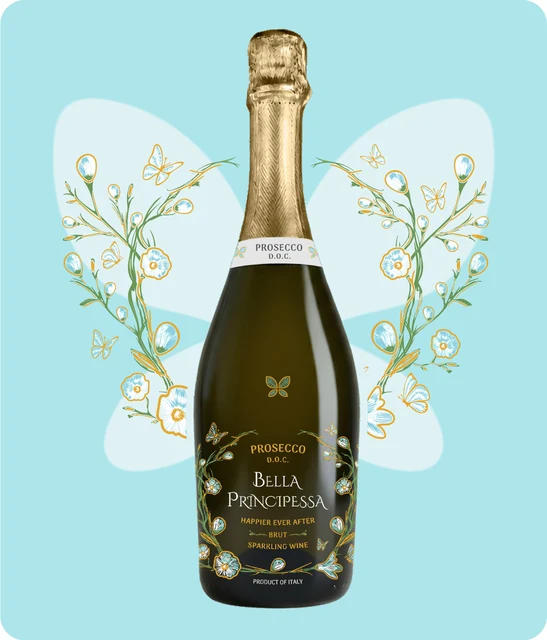
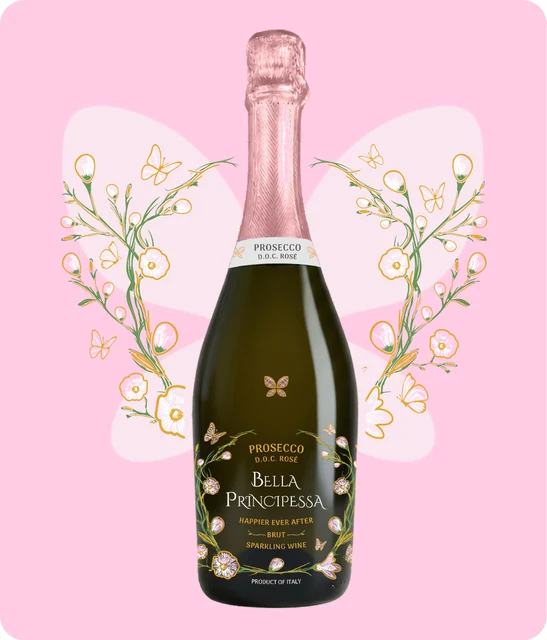
Bella Principessa Prosecco DOC and Bella Principessa Prosecco DOC Rosé are both Prosecco DOC from the province of Treviso, and both are Brut. DOC says where, Brut says how dry.
Where DOC sits in Italian wine
Italy has had DOC rules since 1963. From the broadest category to the strictest, Italian wine labels run: Vino (table wine), IGT (a wider region with looser rules), DOC, and DOCG (DOC plus a “guaranteed” tier with stricter rules). In European Union terms, DOC and DOCG wines are both PDO wines, “protected designation of origin” (DOP in Italian). You may see either on a label. How DOC and DOCG differ.
Is there Champagne DOC?
No. DOC is Italian. France protects Champagne under its own system, AOC (Appellation d’Origine Contrôlée). Same idea, different language and rulebook.
For the bigger picture, start with what Prosecco is; the grapes are in Prosecco grapes and the map in where Prosecco is made.
 The long read, in the JournalWhat is Prosecco? Yes, it’s wine. Here’s the rest6 min read →
SourceProsecco DOC production regulation (Consortium), Italian Ministry of Agriculture, EU Regulation 2019/33, Il Sole 24 Ore, Wine Spectator.
Keep this answer
Print it, save it, or send it to whoever asked.
 Il Bar di StaseraSophie’s 40th