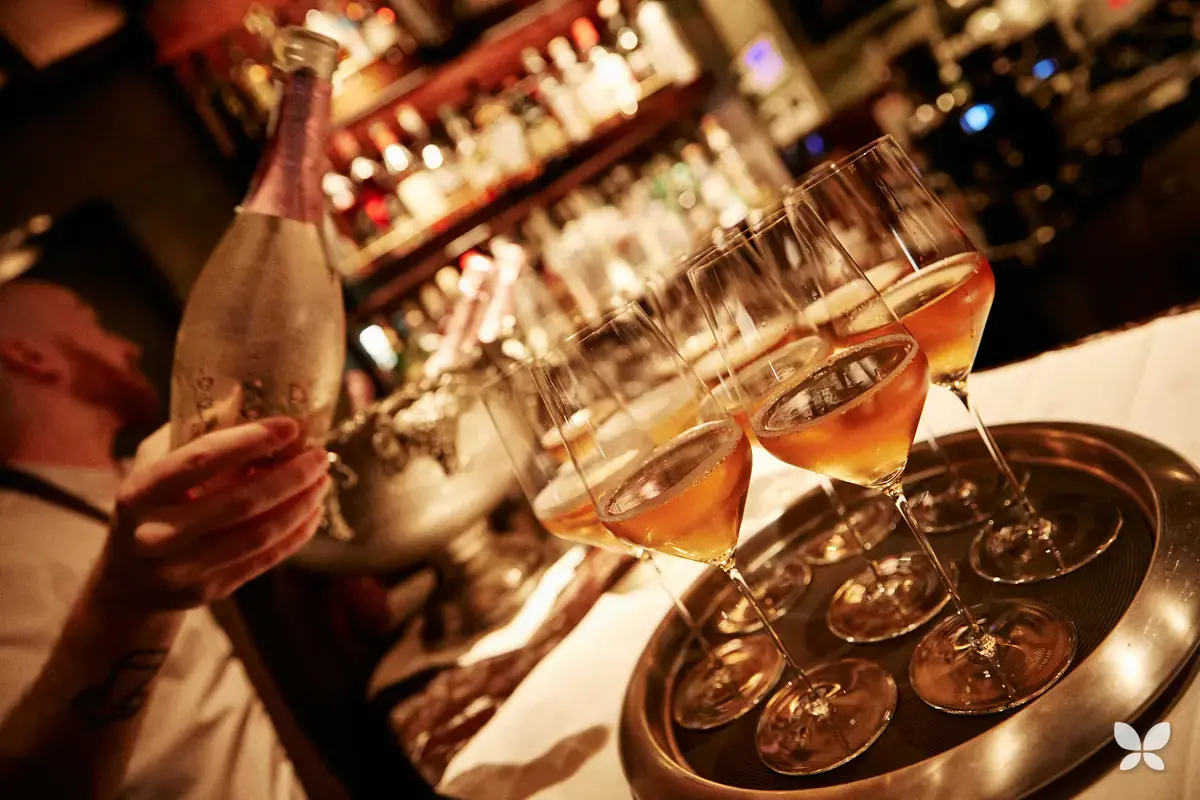
The short answer
Prosecco is the better pick for mimosas, spritzes, parties and value; Champagne for a rich dinner or one special bottle. Prosecco comes from northeast Italy, made mostly from Glera with its bubbles made in a tank, so it tastes fresh and fruity. Champagne comes from France, with its bubbles made in each bottle, so it tastes toasty.
 Answered by Michael Goldstein · Founder, Bella Principessa
Updated on
The full answer
In this answer 10 parts
The verdict, occasion by occasion
| Occasion | Better pick | Why |
|---|---|---|
| Mimosas, Bellinis, spritzes | Prosecco | Its fresh fruit suits juice and bitters; Champagne’s toasty notes disappear under orange juice |
| A party or wedding toast | Prosecco | Same celebration, more bottles for the budget |
| Aperitif before dinner | Either | Prosecco is lighter and livelier; Champagne is more serious |
| Fried food, salty snacks, sushi | Prosecco | Bright bubbles and fruit cut through salt and oil |
| Roast chicken, cream sauces, aged cheese | Champagne | More body and depth from bottle aging |
| One bottle that is the main event | Champagne, if that’s what you love | Complexity is the point |
Paying more for Champagne doesn’t make a mimosa better. The orange juice wins either way.
Prosecco vs Champagne at a glance
| Prosecco | Champagne | |
|---|---|---|
| From | Northeast Italy: nine provinces of the Veneto and Friuli Venezia Giulia | The Champagne region of France |
| Grapes | Glera, at least 85% | Chardonnay, Pinot Noir, Meunier |
| Where the bubbles are made | In one large sealed tank | In each bottle |
| Time on the yeast | Short; bottled young | At least 15 months in the cellar for non-vintage, 3 years for vintage |
| Pressure in the bottle | At least 3 bar (fully sparkling) | About 6 bar |
| Tastes of | Green apple, pear, white flowers | Toast, brioche, pastry |
| Sweetness words | The same scale: Brut is dry, Extra Dry is softer | The same scale; most is sold as Brut |
Why they taste so different
Everything follows from where the second fermentation happens. Champagne’s happens inside each bottle, and the wine then rests on its spent yeast: at least 15 months in the cellar for non-vintage Champagne, 12 of them on the yeast, and three years for vintage. That long contact is where the brioche and toast come from. It is slow, careful and expensive.
Prosecco’s happens in a large sealed tank, and the wine is bottled young. Less time with the yeast keeps the grape’s own green apple, pear and white flowers at the front. It is faster, which is the main reason Prosecco costs less.
Champagne is built around time. Prosecco is built around freshness.
Is Prosecco a type of Champagne?
No. Champagne is a protected name for sparkling wine from the Champagne region of France, and Prosecco is a protected name for sparkling wine from its own area of northeast Italy. Calling Prosecco “champagne” is like calling a Napa Cabernet “Bordeaux”: people know what you mean, and one of them will correct you.
In the US, “Champagne” is classed as a semi-generic name, so a few older American labels may still use it next to their own place of origin. On anything from Europe, it means the French original.
Is Champagne better quality?
It costs more to make, because bottle aging takes time, labor and cellar space. That makes it different, not automatically better. A well-made Prosecco is exactly what it sets out to be: young, fresh and fruity. Every party has a guest who will only drink it if it’s French, and who is on a fourth glass of your Prosecco by the time anyone checks.
Is Prosecco just cheap Champagne?
Which is sweeter?
Neither, by nature. Both use the same sweetness words, with the same trap: Extra Dry is sweeter than Brut. A Brut Champagne and a Brut Prosecco are both dry, and most Champagne is sold as Brut. On the Prosecco shelf, Brut is the crisp one and Extra Dry the softer one.
Which has more bubbles?
Champagne is under more pressure, about 6 bar in the bottle. A fully sparkling Prosecco must have at least 3 bar, and its bubbles feel lighter and frothier. More is not better, just different. A frothy bubble is exactly what you want on top of a spritz.
Which has more alcohol?
It depends on the bottle more than the name. Fully sparkling Prosecco must be at least 11% alcohol. For any two bottles, read the percentage on each label: in equal pours, the higher number holds more alcohol.
And the rest of the sparkling wine aisle?
Spain’s Cava and Italy’s Franciacorta are made the Champagne way, in the bottle. Prosecco is the best known of the sparkling wines built around the tank and fresh fruit. For choosing a bottle of Prosecco itself, see Prosecco brands: how to choose a good bottle.
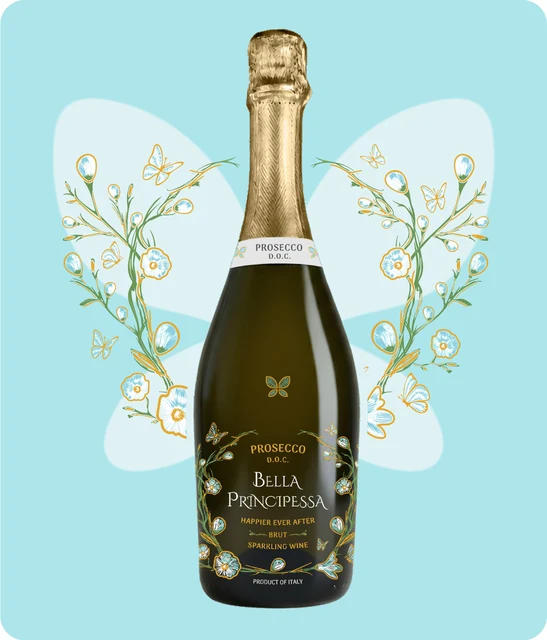
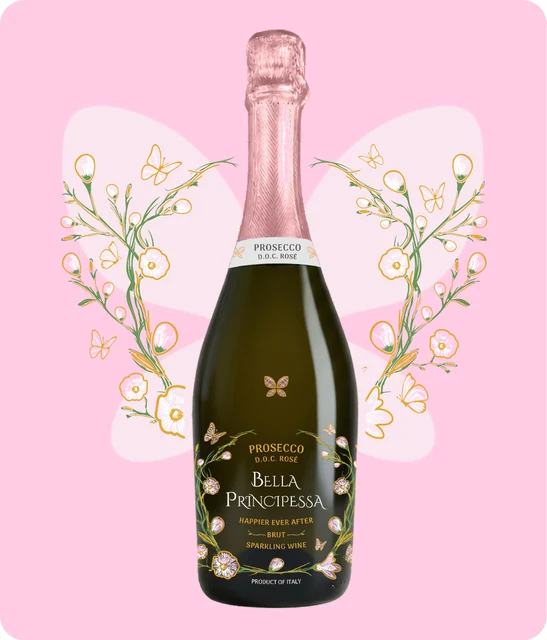
For the moments where Prosecco wins, we make Bella Principessa Prosecco DOC and Bella Principessa Prosecco DOC Rosé, both Brut.
 The long read, in the JournalThe best Prosecco brands: how to choose a good bottle6 min read →
SourceProsecco DOC consortium, prosecco.wine · Comité Champagne, Champagne at a glance and the Champagne-making process (PDF) · French Ministry of Agriculture, Champagne AOC rules (2025) · Italian Ministry of Agriculture, Prosecco DOC production rules (2025) · EUR-Lex, Regulation (EU) 1308/2013, Annex VII · eCFR, 27 CFR 4.24 · TTB, US/EU Wine Trade Agreement · Comité Champagne, Dosage · WSET, A guide to sparkling wine production methods · Wine Spectator, How Champagne is made
Keep this answer
Print it, save it, or send it to whoever asked.
 Il Bar di StaseraSophie’s 40th